


Don’t just buy the tool. Master the art of the practice.
**Meditation Practice** is the art of returning to the present moment. But for the modern mind, silence can be deafening. That is why we curate specific **”Anchors”**—physical tools designed to hold your attention when your mind wanders.
Whether you resonate with **Sound Healing** using a Singing Bowl, prefer the **Somatic Grounding** of a Zafu Cushion, or need the **Active Focus** of a Tongue Drum, this collection provides the essential infrastructure for your daily ritual.
The Pathways Guide: Are you an Auditory, Visual, or Kinetic meditator?
- Auditory Path: Singing Bowls, Tongue Drums, Kalimbas
- Kinetic Path: Meditation Cushions, Malas (Touch)
- Visual Path: Zen Gardens, Trataka (Gazing)
No products were found matching your selection.
🧘 What is a “Meditation Practice”? (Sadhana)
In Sanskrit, a daily spiritual practice is called Sadhana. It is not something you “complete”; it is something you “cultivate.”
Many beginners fail because they try to force their minds into silence. Tools are the bridge. By giving the “Monkey Mind” a job—like listening to a frequency or raking sand—you bypass the ego’s resistance and slip effortlessly into a Theta state (deep relaxation). Our collection is organized by Sensory Pathways to help you find your unique entry point into stillness.
🛤️ Which Path Fits Your Mind Type?
Meditation is not one-size-fits-all. Choose the tool that aligns with your dominant sense:
| Path Type | How it Works | Essential Tools |
|---|---|---|
| Auditory (Sound) | Brainwave Entrainment. Uses specific frequencies to synchronize brain hemispheres. Best for overthinkers who need to “drown out” inner chatter. | Singing Bowls (Om vibration), Tongue Drum (Melodic trance), Kalimba (Lullaby tones). |
| Somatic (Body) | Grounding. Focuses on posture and physical sensation. Best for those who feel disconnected or “floaty.” | Zafu & Zabuton (Spine alignment), Mala Beads (Tactile counting). |
| Visual (Sight) | Focus (Dharana). Training the eyes to rest on a single point or pattern. Best for creatives and visual learners. | Zen Gardens (Pattern creation), Thangka Paintings (Visualization), Candle Gazing. |
🎶 Creating Your Own “Sound Bath”
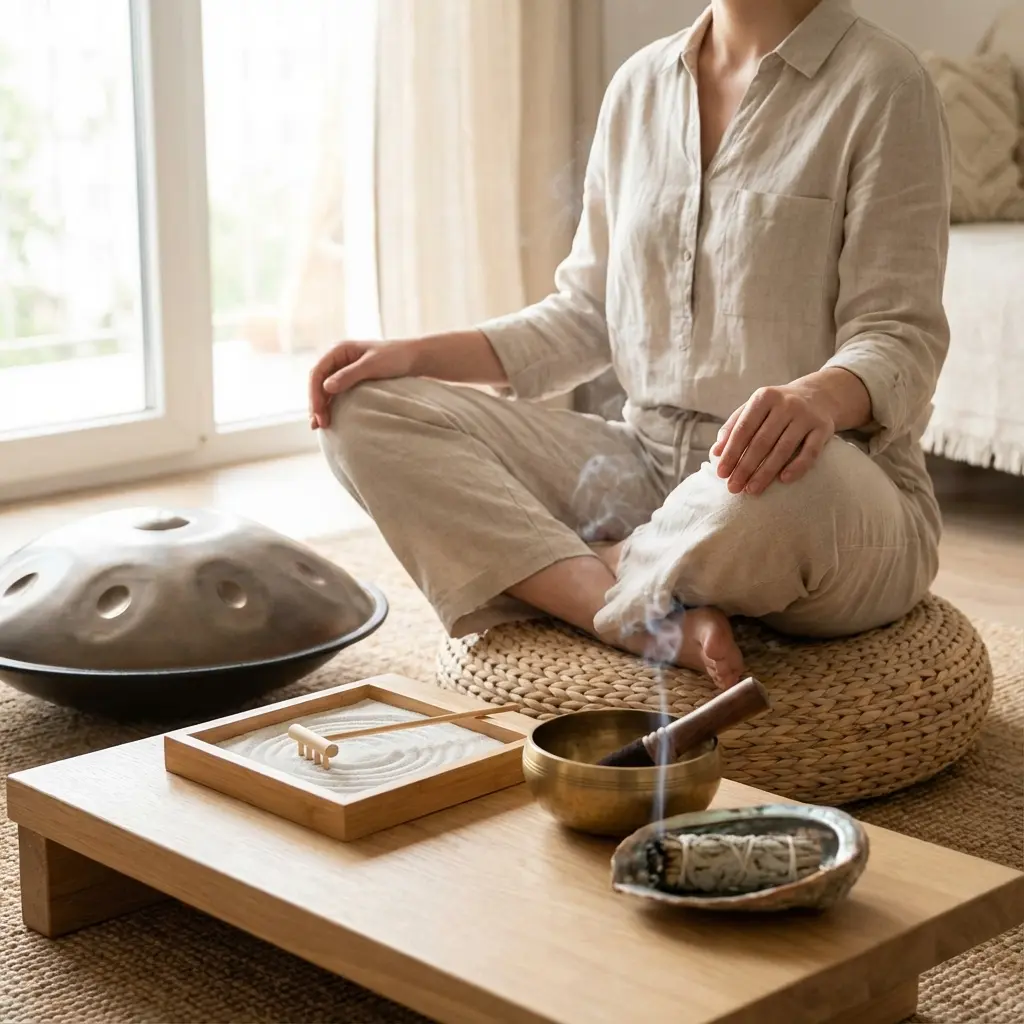
You don’t need to visit a studio to experience Sound Healing. You can build a Sonic Sanctuary at home.
The Setup:
- Sit comfortably on your Meditation Cushion.
- Strike a Singing Bowl to clear the space.
- Begin playing a Steel Tongue Drum or Kalimba intuitively. Do not try to compose a song; just listen to the resonance.
- Allow the vibrations to wash over you. This is “Active Meditation”—your hands are moving, but your mind is still.
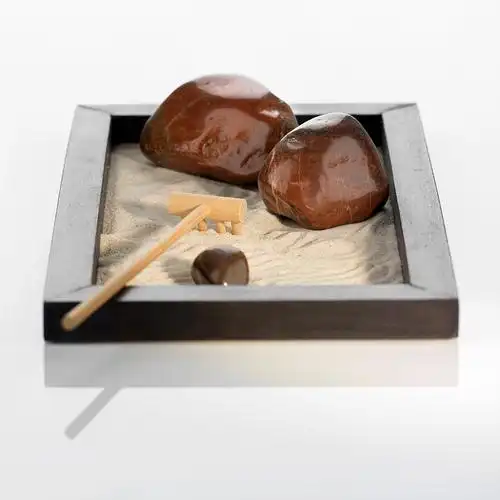
🌿 Zen Gardens: Mindfulness in Motion
For those who find sitting still impossible, the Mini Zen Garden (Karesansui) is the answer.
Based on Japanese dry landscapes, the act of raking the sand represents the ripples of water. It teaches Impermanence (Wabi-Sabi). You create a pattern, admire it for a moment, and then wipe it smooth. It is a powerful “Reset Button” for the brain during a stressful workday.
🧱 The Importance of the Seat (Asana)
The ancient yogis developed physical postures (Asana) solely to prepare the body to sit in meditation.
If your hips are tight or your back aches, you cannot transcend the body. A Buckwheat Zafu elevates your pelvis, allowing your knees to drop and your spine to stack naturally. This physical stability creates the container for mental stability.
❓ Frequently Asked Questions
Q: How long should I meditate each day?
A: Consistency beats duration. It is better to practice for 5-10 minutes every day than for an hour once a week. Use a tool like a Kalimba or Zen Garden to make those 10 minutes enjoyable rather than a chore.
Q: I can’t stop thinking when I meditate. Am I doing it wrong?
A: No! The nature of the mind is to think. The goal is not to stop thoughts, but to notice them without judgment. Using an “Anchor” like a Mala (counting beads) or a Sound Bowl gives your mind a job, reducing the volume of random chatter.
Q: What is the difference between a Tongue Drum and a Handpan?
A: Both are sound healing instruments. A Tongue Drum is smaller, played with mallets, and has a bell-like tone. It is much more affordable and durable. A Handpan is larger, played with hands, and has a complex, harp-like sound. For beginners, we recommend the Tongue Drum.
Q: Can I combine these practices?
A: Absolutely. A common routine is: Sit on your Cushion -> Light Incense -> Play a Singing Bowl to start -> Do 10 minutes of breathwork -> End with a gratitude prayer.
Start your journey inward. Shop our curated collection of meditation practice tools below.
📝 Curated by: Buddha Bodhis Spiritual Team