



Table of Contents
✅What’s the Difference Between Natural Crystals and Artificial Crystals?
In today’s jewelry market, many “colored crystals” are actually irradiated quartz or man-made glass disguised as natural gemstones. For collectors and spiritual jewelry lovers, such as the community of Buddha Bodhis, understanding these differences is key to preserving authenticity and energy integrity.
Here are the most notable distinctions:
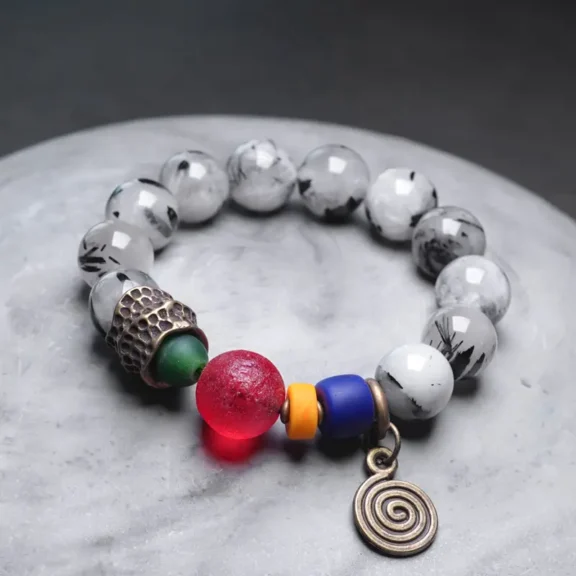
- Natural crystals show irregular color zones, inner inclusions, and liquid or gas bubbles.
- Artificial crystals (lab-grown quartz) display perfectly even colors and often contain a small seed nucleus at the center.
- Bright blue or orange hues are typically dyed or irradiated, not natural.
- Artificially colored quartz fades with time, losing its brilliance and spiritual energy.
- Under sunlight, natural quartz shows fine horizontal or silky thread-like textures, while fake ones (glass) do not.
- Natural quartz refractive index: 1.54
Fake quartz or glass refractive index: below 1.00
🔍 How to Identify Real Natural Crystals
Here are seven simple yet effective methods to distinguish real from fake crystals:
- Visual Inspection
Natural crystals always contain slight imperfections — small inclusions, inner fibers, or cloudy zones. Artificial ones are too flawless. - Tongue Test
When you gently lick a natural crystal, it feels cool even in warm weather. Fake crystals or glass feel room temperature or warm. - Light Observation
Hold the crystal under sunlight. A real crystal radiates brilliant internal light reflections from all angles, unlike glass. - Hardness Test
Real quartz has a Mohs hardness of 7 — it can scratch glass easily. If the stone gets scratched, it’s likely fake. - Polarizing Lens Test
Rotate the crystal 360° under a polarizing microscope. Natural crystals show four light and four dark shifts, while fakes stay uniform. - Magnifying Glass Inspection
Under a 10x magnifier, visible air bubbles usually indicate glass rather than real quartz. - Thermal Conductivity Test
When tested with a thermal conductivity meter, natural crystals respond with a noticeable rise in reading (to the yellow zone), while artificial ones stay static.
💎 Crystal vs. Glass — Key Differences
| Property | Natural Crystal | Glass |
|---|---|---|
| Material | Silicon dioxide (SiO₂) crystal | Silica-based molten mixture |
| Hardness | Mohs 7 (very hard) | Mohs 5.5 (soft) |
| Thermal Feel | Cool to touch | Feels warm |
| Light Transmission | Birefringent (polarized) | Non-polarized |
| Durability | Long-lasting, won’t fade | May yellow over time |
| Processing | Cut and polished (cold method) | Molded by heat |
| Value | High — collectible and spiritual | Low — decorative only |
At Buddha Bodhis, we always emphasize authentic crystals. Genuine quartz not only has visual beauty but also carries natural energy vibrations — something artificial glass cannot replicate.
✨ Why Authentic Crystals Matter
- Energy Integrity: Real crystals resonate with your aura, promoting healing and calmness.
- Long-Term Beauty: Genuine quartz maintains color and luster indefinitely.
- Investment Value: Natural gemstones appreciate over time, unlike mass-produced synthetics.
- Symbolism: Each authentic crystal holds geological history and universal energy — unique to its formation.
Choosing authentic crystals from trusted brands like Buddha Bodhis ensures both spiritual and material value in every piece you wear.
💬 FAQs About Identifying Real Crystals
1. How can I tell if my crystal is natural or man-made?
Check for natural inclusions, uneven colors, and a cool feeling to the touch — signs of a genuine crystal.
2. Are man-made crystals worthless?
They can still look beautiful but lack the energetic and healing properties of natural stones.
3. Can real crystals have bubbles inside?
Usually no — visible bubbles often indicate glass or synthetic quartz.
4. Why does my crystal fade in color?
Exposure to sunlight or radiation-treated dyes can cause artificial stones to lose color.
5. Is it safe to wear fake crystals?
Yes, but they don’t offer the same vibrational healing benefits as authentic ones.
6. What’s the easiest home test for real crystals?
Try the tongue or scratch test — real quartz stays cool and can scratch glass.
7. How do jewelers confirm authenticity?
Professionals use polarizing microscopes and thermal conductivity meters for precise identification.
8. Are all clear quartz crystals natural?
No, many clear quartz stones on the market are lab-grown, so check the source before buying.
🧭 Final Tip
When in doubt, always purchase from verified gemstone experts like Buddha Bodhis — where every crystal is carefully selected, ethically sourced, and authentically tested to ensure its true natural origin.